
Lump-Sum Windfalls vs. Regular Monthly Contributions: Which Builds More Over Time?
A side-by-side look at how one-off deposits compare to consistent monthly saving for long-term retirement fund growth, with the trade-offs of each approach.
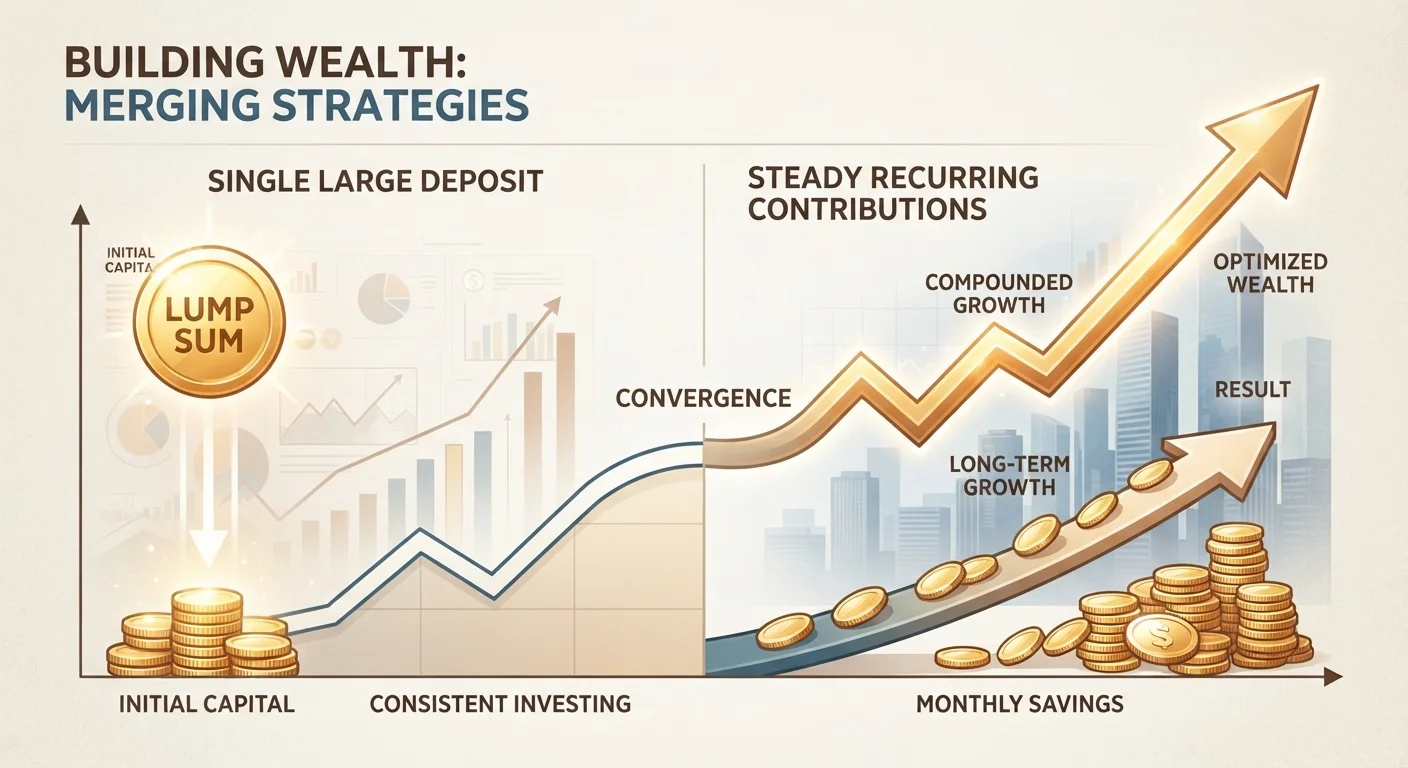
Photo: shapingfinances.com editorial
—— In This Article
Key Takeaways
- Lump-sum investing typically exposes more capital to market growth sooner, which can produce higher end balances when markets trend upward.
- Monthly contributions reduce timing risk by spreading purchases across different price points, a principle known as dollar-cost averaging.
- For adults in their 40s and 50s, the most effective approach is often to use windfalls immediately and maintain regular contributions alongside them.
- IRS catch-up contribution rules allow adults aged 50 and older to deposit more each year into 401(k) and IRA accounts.
- Neither strategy guarantees outcomes; both carry investment risk and should align with your personal financial plan.
How each approach works
A lump-sum windfall is a one-time deposit of a significant amount, typically from an inheritance, job bonus, severance, property sale, or tax refund. Lump-sum investing means moving that money into your retirement or investment accounts in a single transaction rather than holding it in cash.
Regular monthly contributions are fixed or variable deposits made on a schedule, usually aligned with pay cycles. When applied consistently across time and varying market prices, this method is the practical form of dollar-cost averaging. For more on why that consistency matters, see how regular contributions reduce timing risk.
Both approaches direct money toward the same destination. The difference is timing and frequency, which affect how much your money compounds and how exposed it is to short-term market volatility.
The compounding advantage of investing early
Compounding means your returns generate their own returns. The longer money stays invested, the larger that effect becomes. A lump sum deposited today starts compounding immediately on the full amount. Monthly contributions start compounding only on each installment as it arrives, so the full balance compounding effect builds gradually.
Historical analysis by investment researchers consistently finds that lump-sum investing outperforms spreading the same total over months in the majority of market environments, because markets tend to rise more often than they fall over multi-year periods. However, past market behavior does not guarantee future results, and any investment carries risk of loss.
~68%
Share of periods where lump-sum beats phased investing
Vanguard research across US, UK, and Australian markets found lump-sum investing outperformed a 12-month phased approach in roughly two-thirds of historical rolling periods.
$7,500
IRS catch-up contribution limit for workers 50-plus (401k, 2024)
The IRS allows workers aged 50 and older to contribute an additional $7,500 above the standard 401(k) limit each year, per IRS Publication 560.
$1,000
IRA catch-up contribution limit for workers 50-plus (2024)
The IRS permits an extra $1,000 annual contribution to traditional and Roth IRAs for individuals aged 50 and older, per IRS guidelines.
The practical implication for someone in their 40s or 50s: if you have idle cash sitting in a low-yield account and a clear investment plan, delay costs you compounding time you cannot recover. That said, deploying a windfall wisely requires having an emergency fund in place first and carrying no high-interest debt. See common saving pitfalls that quietly erode retirement progress for mistakes that often undercut this logic.
Where monthly contributions have an edge
Monthly contributions remove two friction points that derail many mid-life savers: the temptation to wait for a better moment to invest, and the emotional difficulty of watching a large single deposit drop in value shortly after it is made.
When you contribute a fixed amount each month, you buy more units when prices are low and fewer when prices are high. Over time this can lower your average cost per unit relative to investing everything at a single high point. The benefit is not dramatic in rising markets, but in flat or volatile ones it provides meaningful protection.
Automation matters here. Contributions deducted directly from a paycheck or set up as automatic transfers are much less likely to be skipped during busy or stressful months. This behavioral consistency is worth something regardless of market conditions.
Adults aged 50 and older can also take advantage of IRS catch-up contribution limits, which allow higher annual deposits into 401(k) and IRA accounts than the standard limits. Maximizing these through consistent payroll deductions is a disciplined and tax-efficient way to close a savings gap. For context on where saving rate fits relative to investment return, see how savings rate compares to investment return in your 40s and 50s.
Combining both strategies in mid-life
For most adults between 40 and 60, the realistic picture is not a choice between these two approaches. It is how to use each one when it applies.
Monthly contributions handle the steady accumulation from employment income. A windfall, when it arrives, should be invested as promptly as your financial position allows, which means after securing three to six months of living expenses in a liquid account and addressing any high-interest debt. The windfall does not replace your monthly contributions; both run in parallel.
| Criterion | Lump-sum windfall investing | Regular monthly contributions |
|---|---|---|
| Compounding start | Immediate on full amount | Gradual as deposits accumulate |
| Market timing risk | Higher (single entry point) | Lower (spread across prices) |
| Behavioral discipline required | One decision, then done | Sustained monthly action |
| Works with catch-up limits | Yes, if within annual limits | Yes, via payroll deduction |
| Best market environment | Trending upward markets | Volatile or sideways markets |
| Requires a windfall | Yes | No |
If the amount is large enough to feel genuinely unsettling to invest all at once, spreading it over three to six months is a reasonable middle path. You give up some potential compounding upside, but you protect against the specific regret of investing at a short-term peak. Whatever timeline you choose, commit to it and stick to it rather than waiting for the right moment.
For how these savings eventually become income, see building passive income streams through retirement and a step-by-step drawdown framework.
This article is general financial information and education only, not personalized financial, investment, or tax advice. Speak with a licensed financial adviser before making decisions specific to your situation.

Saving Strategies Editorial Team
Saving Strategies Editorial Team is the collective byline for our editorial team and contributor network. Articles published under this byline or an editorial pen name are researched, written, and reviewed according to our editorial standards for clarity, consistency, and independence before publication.
View author profile