
Savings Rate vs. Investment Return: Which Lever Matters More in Your 40s and 50s?
Understand the relative impact of how much you save versus how your money grows, and where to focus your energy at different stages of mid-life.
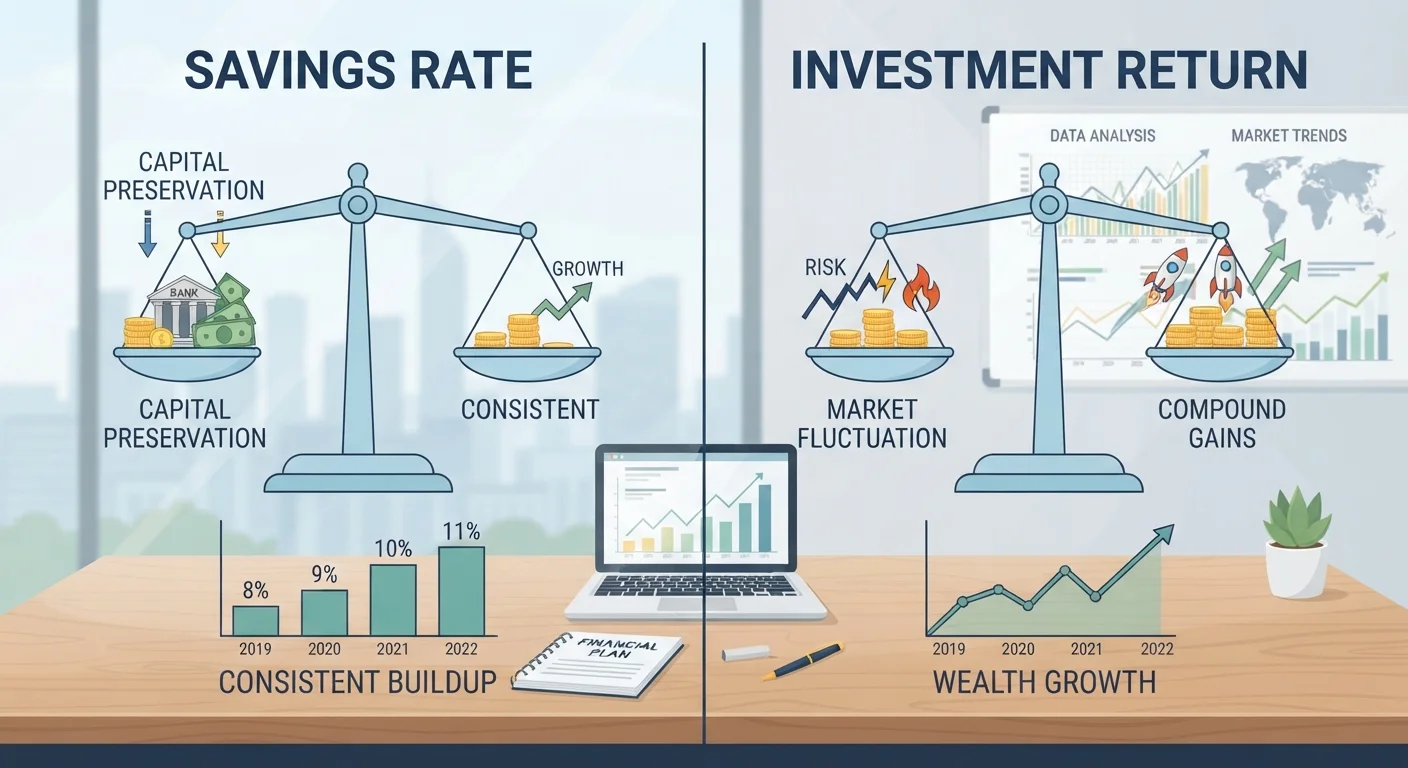
Photo: shapingfinances.com editorial
—— In This Article
Key Takeaways
- Your savings rate has more direct impact on retirement outcomes when you are in your 40s and have less accumulated wealth.
- Investment returns grow more influential as your portfolio balance grows larger relative to your annual contributions.
- Catch-up contributions allow adults 50 and older to add extra money to tax-advantaged accounts each year.
- Cutting investment fees is one of the most controllable ways to improve effective returns without taking on more risk.
- Most mid-lifers benefit from improving both levers, but limited time or energy should go to savings rate first.
Why the debate matters differently at mid-life
Personal finance guidance often treats savings rate and investment return as equally important at all times. They are not. The weight each lever carries depends heavily on how large your existing portfolio is relative to what you contribute each year.
Consider a straightforward example. If you have $50,000 saved and contribute $10,000 annually, your contributions represent 20% of your balance. A 1-percentage-point improvement in return on $50,000 adds $500 per year. Adding $2,000 more in contributions adds $2,000 immediately and compounds from there. Contributions dominate at this stage.
Shift the scenario a decade forward. With $400,000 saved, that same 1-point improvement in annual return adds $4,000 per year. Your $10,000 contribution now represents just 2.5% of your balance. Returns begin to matter more.
This arithmetic is not a reason to ignore one lever entirely. It tells you where to concentrate effort when time and attention are finite. For a practical audit of your current position, the mid-life money audit checklist can help you map where you stand before deciding where to push.
The savings rate lever: what you can control most directly
Your savings rate is the percentage of gross income you set aside each year across all accounts. At 40, most people are not saving enough. Data from the Federal Reserve's Survey of Consumer Finances consistently shows median retirement savings for households in their early 40s fall well short of common retirement benchmarks.
The good news is that increasing your savings rate is one of the few moves you can make unilaterally. You do not need market conditions to cooperate.
Concrete actions worth taking in your 40s include:
- Maximizing your 401(k) up to the IRS annual limit, and capturing any employer match in full before directing money elsewhere.
- Opening or funding a traditional or Roth IRA to use the full annual contribution limit.
- Running an expense audit to find recurring costs that can be redirected to savings without affecting daily quality of life.
Once you turn 50, the IRS permits catch-up contributions: additional amounts you can add to 401(k)s and IRAs above the standard limits. Using these fully can add meaningfully to your balance over a 10-to-15-year runway. Avoiding the common habits that quietly chip away at saving progress is equally important; the saving pitfalls that erode retirement progress article covers this in detail.
Use the employer match before anything else
An employer match is an immediate 50% to 100% return on the matched portion of your contribution, which no market return can reliably replicate. If you are not contributing enough to capture the full match, that is the first gap to close, even before paying down moderate-rate debt. Check your plan documents or HR portal to confirm your match formula and threshold.
The investment return lever: where it earns its place
Investment return is partly outside your control: markets fluctuate and past performance does not predict future results. However, two components of return are directly within reach: fees and asset allocation.
Investment fees compound in reverse. A fund charging 1% annually versus one charging 0.1% may seem like a minor difference, but on a $300,000 balance over 15 years, that gap can remove tens of thousands of dollars from your final balance. The full analysis of what investment fees cost over a decade shows how these figures accumulate.
Asset allocation, the split between growth-oriented and more stable assets, should shift as you approach retirement. Staying too conservative too early limits growth; staying too aggressive too late exposes your balance to sequence-of-returns risk (the danger that a market drop shortly before or after retirement does disproportionate damage). The guide to asset allocation in your 40s and 50s walks through how to think about this transition.
| Savings rate | Investment return | |
|---|---|---|
| Degree of personal control | High: you set the amount | Partial: fees and allocation are controllable; market returns are not |
| Greatest impact when | Portfolio balance is relatively small | Portfolio balance is large relative to annual contributions |
| Key actions available | Maximize contributions, use catch-up limits, cut expenses | Reduce fees, adjust asset allocation, rebalance |
| Risk involved | Requires income or spending adjustments | Allocation changes carry market and sequence risk |
| Time horizon sensitivity | More powerful earlier; each added dollar compounds longer | More powerful as balance grows in mid-to-late 50s |
| Tax-advantaged tools | 401(k), IRA, HSA, catch-up contributions after 50 | Tax-efficient fund selection, account type placement |
How to sequence your effort across this decade
For most people in their early 40s, the sequence is straightforward: first, eliminate high-interest debt, because its cost typically exceeds any realistic investment return. The debt vs. investing decision framework can help clarify that priority. Second, hit the full employer match. Third, maximize tax-advantaged contributions. Only after those steps does squeezing an extra fraction of a percentage point from portfolio construction matter much.
By your 50s the calculus shifts. Your balance is likely larger, so allocation decisions and fee levels apply to a bigger number. Your 50s also typically bring higher earnings and lower childcare expenses, creating room to both save more and invest more thoughtfully at the same time. The savings surge opportunity of your 50s explains why this window is worth treating as a priority period.
The four percent rule and withdrawal strategy options offers useful context on how your accumulated balance translates into sustainable retirement income, which can make the tradeoffs here feel more concrete.
This article is for general informational and educational purposes only. It is not personalized financial, investment, or tax advice. Contribution limits, tax rules, and account types change over time; verify current figures with the IRS or a licensed financial professional. Consult a qualified financial adviser before making decisions based on your individual circumstances.

Saving Strategies Editorial Team
Saving Strategies Editorial Team is the collective byline for our editorial team and contributor network. Articles published under this byline or an editorial pen name are researched, written, and reviewed according to our editorial standards for clarity, consistency, and independence before publication.
View author profile